
Proforma Invoice Financing: How Businesses Fund Orders Before Billing
Proforma invoice financing helps fund orders before billing. Learn uses, format, examples, and how businesses manage upfront costs effectively.

Delayed payments continue to strain business cash flow in India. The Economic Survey 2025–26 estimates ₹8.1 trillion locked in delayed payments, affecting MSME liquidity and growth.
For many businesses, the gap between order confirmation and payment creates immediate funding pressure, especially when procurement or production must begin upfront. This is where proforma invoice financing becomes relevant. It helps businesses align funding with confirmed orders and manage upfront costs without waiting for final invoicing.
In this guide, we will explain how proforma invoices work, where they are used, and how financing fits into your business. Let’s get started!
Key Takeaways
A proforma invoice outlines pricing, quantities, and terms before delivery, helping both parties confirm details early in the sales cycle.
It does not request payment but is widely used for approvals, budgeting, and planning across finance and procurement teams.
Proforma invoice financing helps businesses arrange funds against confirmed orders, covering upfront costs before billing begins.
This approach is useful when orders require immediate spending but payments are scheduled after delivery, creating a cash gap.
With the right funding partner, businesses can execute orders on time without straining internal cash reserves or delaying growth
What Is a Proforma Invoice?
A proforma invoice is a preliminary document shared by a seller with a buyer before goods or services are delivered. It outlines key details such as product or service descriptions, pricing, quantities, delivery timelines, and payment terms, giving both parties clarity before the transaction is finalised.
Unlike a final invoice, a proforma invoice is not a demand for payment. Instead, it acts as a planning and confirmation document that helps buyers secure internal approvals and sellers prepare for fulfilment. Businesses commonly use proforma invoices in B2B transactions, exports, custom orders, or projects where costs and timelines need to be agreed upon in advance.
When proforma invoices lock in costs before fulfilment, access to timely capital becomes critical. Recur Club offers collateral-free funding of up to ₹10 Cr, with quick term-sheet turnaround.

How Does Proforma Invoice Financing Work?
This works best when orders are confirmed, but payment will be received only after delivery, while costs need to be incurred upfront.
Proforma invoice financing typically follows this flow:
The order is confirmed with the buyer
A proforma invoice is issued with pricing and terms
Funding is arranged based on the confirmed order
Production or procurement begins
The final invoice is raised after delivery
Example: A D2C brand receives a bulk order worth ₹30 lakh from a retail partner. It shares a proforma invoice with product details, GST, and delivery timelines. Since payment will come after delivery, the brand arranges funding based on the confirmed order. This allows it to procure raw materials and complete production without delaying fulfilment or stretching internal cash.
This avoids delays in execution, reduces reliance on internal reserves, and helps the business fulfil orders on time without cash flow strain.
Types of Proforma Invoices
Proforma invoices can be issued in different forms depending on the nature of the transaction and how the document is used in planning or execution.
Standard proforma invoice: Used in routine B2B transactions to confirm pricing, quantities, and terms before delivery.
Export proforma invoice: Issued for cross-border trade to support customs documentation, foreign exchange planning, and import/export approvals.
Project-based proforma invoice: Used for long-term or custom projects where pricing, scope, and timelines are agreed in advance, often linked to milestones.
Advance payment proforma invoice: Issued when suppliers require partial or full upfront payment before starting production or procurement.
Each type serves the same core purpose, early-stage clarity, but is tailored to how businesses plan costs, approvals, and execution in different scenarios.
Benefits of Using Proforma Invoice Financing
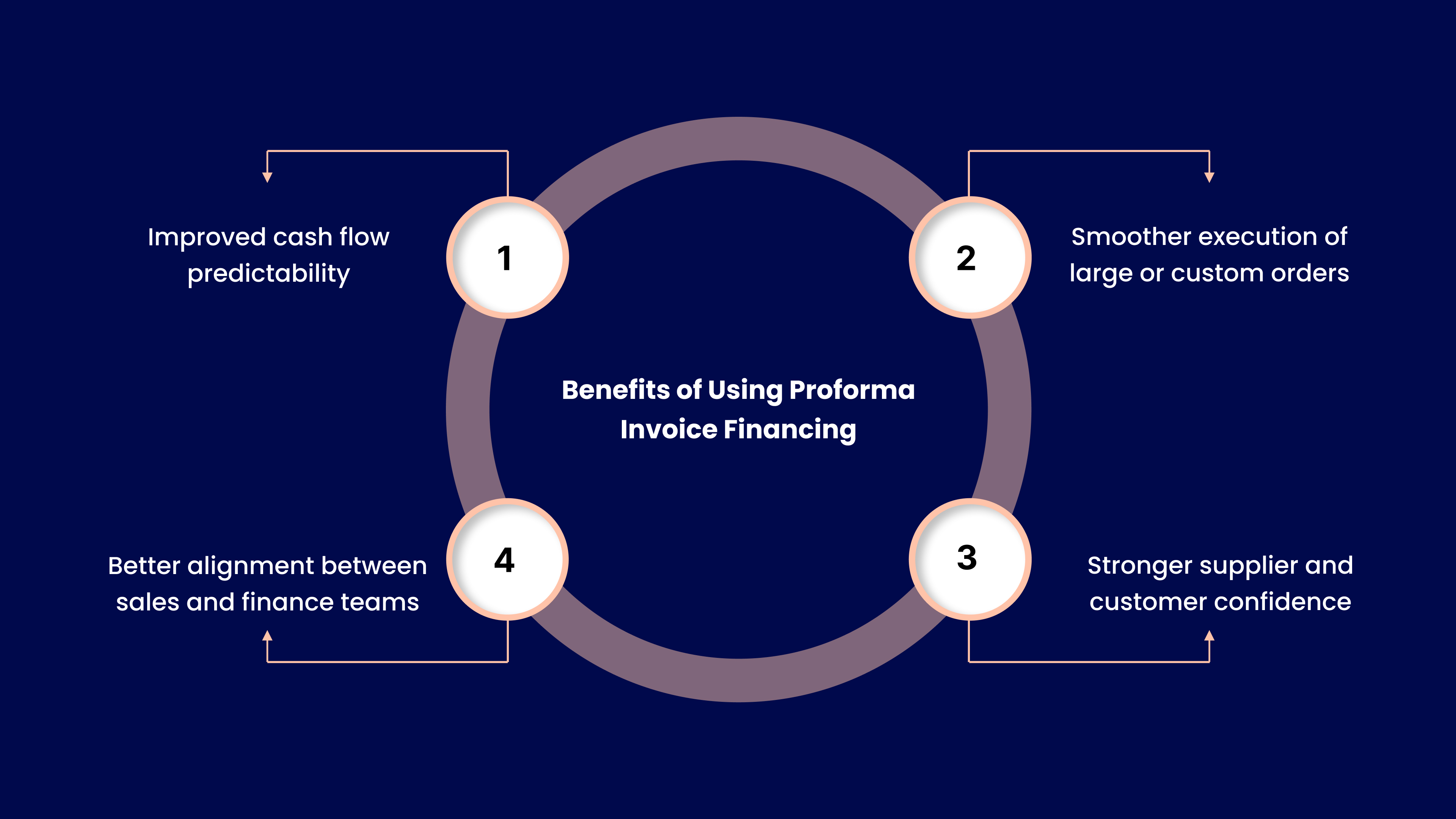
Proforma invoice financing helps businesses manage the gap between order confirmation and payment, especially when costs must be incurred upfront.
Funding before billing begins: Access capital as soon as the order is confirmed, instead of waiting for the final invoice and payment cycle.
Start production or procurement on time: Avoid delays caused by a lack of funds when raw materials or resources are needed immediately.
Preserve internal cash for other needs: Keep working capital available for day-to-day expenses instead of locking it into a single order.
Meet supplier payment terms without delays: Pay vendors on time, even when customer payments are scheduled later.
Execute larger orders without cash constraints: Take on high-value or bulk orders with more confidence, knowing funding is aligned with the order stage.
These benefits are most effective when financing decisions are tied closely to actual delivery and payment timelines.
Format and Key Fields of a Proforma Invoice
A proforma invoice follows a structured format to clearly outline the expected transaction. While layouts may vary, most proforma invoices include the following key fields:
Seller and buyer details
Proforma invoice number and issue date
Description of goods or services
Quantity and unit pricing
Applicable taxes or duties (if any)
Delivery or execution timelines
Payment terms
Validity period and disclaimer stating it is not a tax or payment invoice
Including these details ensures the proforma invoice can be reliably used for planning, approvals, and coordination across sales, finance, and operations teams.
Proforma Invoice vs. Conventional Invoice
A proforma invoice is issued before delivery to confirm pricing, quantities, and terms for planning. A conventional invoice is issued after delivery and is a formal request for payment.

Proforma invoices support approvals and budgeting, while conventional invoices trigger payment, accounting, and tax reporting.
Use Cases of Proforma Invoices in Planning, Procurement, and Finance
Proforma invoices are used as early-stage planning tools across operations, procurement, and finance, well before delivery or billing occurs. Common use cases include:
Cash flow planning before payment is due: Provides early visibility into upcoming expenses, allowing finance teams to allocate budgets or arrange funds in advance.
Procurement and production planning: Helps teams plan raw material purchases, production schedules, or service execution before committing resources.
Cross-border and trade transactions: Used to apply for import/export licences, estimate duties and taxes, and plan foreign exchange requirements.
Working capital planning for confirmed orders: Signals expected cash outflows tied to production or fulfilment, making it easier to plan short-term funding needs.
Justifying advance payments or internal approvals: Acts as supporting documentation for management, finance, or procurement sign-offs before execution begins.
Aligning sales, operations, and finance teams: Creates a shared reference point for timelines, costs, and funding requirements, reducing last-minute cash gaps.
This early visibility is what makes proforma invoices especially valuable for businesses operating with tight working capital cycles or order-driven execution models.
When proforma invoices highlight upcoming costs but cash hasn’t come in yet, the funding structure you choose matters. Recur Club connects businesses with institutional lenders to access non-dilutive financing aligned with sales cycles and working capital needs, helping teams plan funding without relying on equity dilution.

5 Simple Steps to Create a Proforma Invoice
Creating a proforma invoice is about clearly defining the scope, pricing, and terms before delivery. A simple approach works best.
Step 1: Define scope and costs
List products or services, quantities, pricing, and any expected costs such as shipping, duties, or project expenses. Align upfront on commercial terms like advances, credit period, and delivery timelines.
Step 2: Add seller and buyer details
Clearly label the document as a Proforma Invoice. Include seller and buyer details, a proforma invoice number, issue date, and any reference to a PO or enquiry.
Step 3: Include line items and totals
Specify item descriptions, quantities, unit prices, taxes (if applicable), and the total estimated value. For cross-border deals, mention currency and key assumptions.
Step 4: State terms and validity
Outline payment terms, delivery timelines, validity period, and any revision or cancellation conditions.
Step 5: Review and share
Ensure figures are accurate, scope is aligned internally, and the document clearly states it is not a tax or payment invoice. Use it as a reference point before raising the final invoice.
At this stage, upcoming cash requirements become visible. Businesses often use this window to arrange funding for production or fulfilment, before delivery and billing begin.
Rather than waiting for the final invoice, this is exactly when you can plug into Recur Club to fund execution: high-growth startups can use Recur Swift to access collateral-free growth capital for proforma-backed orders, while scaling SMEs can leverage Recur Scale for larger working-capital and bill discounting lines aligned to their order book and receivables cycle.
When Should You Use Proforma Invoice Financing?
Proforma invoice financing is most useful when there is a clear gap between upfront costs and incoming payments, and delaying execution is not an option.
Large confirmed orders: When the order size exceeds available cash and requires immediate spending on materials, inventory, or resources.
Long production or delivery cycles: When revenue will be realised only after weeks or months, but costs begin immediately.
Supplier advance requirements: When vendors need partial or full payment before starting work, even though the customer's payment is pending.
Growth phases with rising order volumes: When increasing demand puts pressure on working capital, and internal funds are not enough to support execution.
This approach works best when order visibility is strong, and repayment can be supported through expected cash inflows.
Conclusion
Proforma invoices play a critical role in early-stage planning by giving businesses clarity before delivery and billing. When used correctly, they help finance teams anticipate cash needs, manage working capital, and support smoother execution of orders and projects.
The real value comes from pairing that clarity with the right funding strategy. With better visibility into upcoming costs and timelines, businesses can choose non-dilutive financing structures that align with how cash actually flows, reducing pressure and improving control.
₹3,000+ crore funded
2,000+ businesses supported
150+ institutional lending partners
Ready to fund production before delivery? Book a demo to access bill discounting and working capital up to ₹100 Cr for scaling SMEs.
FAQs
1. What is a proforma invoice used for?
It is used to outline pricing, scope, and terms before goods or services are delivered.
2. Is a proforma invoice legally binding?
No. It is not a demand for payment and can be revised before final invoicing.
3. Can businesses get financing based on a proforma invoice?
In some cases, yes—especially to fund upfront costs tied to confirmed orders.
4. How is proforma invoice financing different from invoice financing?
Proforma invoice financing supports costs before delivery, while invoice financing is based on receivables after delivery.
5. When should a business issue a proforma invoice?
When buyer intent is confirmed but delivery and final billing haven’t yet occurred.
Related Articles

Debt Financing Agreements for Indian Startups: Key Terms and Negotiation Tips
What is a debt financing agreement? A practical guide for Indian startups covering covenants, repayment terms, defaults, and risks.

Financial Forecasting for Startups: Build Projections That Help You Raise Capital
Master financial forecasting for startups with revenue, expense, and cash flow projections to plan growth and attract investors.

B2B Lending Explained: A Practical Guide for Indian SMEs
Understand B2B lending meaning, how it works, types, and when SMEs should use it for faster, non-dilutive business financing.
Talk to our experts and find the right financing solution.
Talk to Our Experts →