CAGR Meaning in Finance: Calculation and Why it Matters for Business Growth

Growth rarely happens in a straight line. Revenues rise and fall, markets shift, and short-term spikes can hide long-term performance. This is why finance teams need a metric that shows how a business grows over time, not just year to year. That’s where CAGR comes in.
CAGR, short for Compound Annual Growth Rate, is widely used in finance to measure consistent growth across multiple years. It helps founders, CFOs, and investors compare performance, assess business momentum, and make clearer decisions around planning and capital.
Key Takeaways
- CAGR measures true long-term growth, showing how a metric compounds annually over time rather than fluctuating year to year.
- It smooths volatility, making uneven growth patterns easier to interpret and communicate to investors, boards, and lenders.
- Widely used for revenue, investments, and market sizing, CAGR enables apples-to-apples comparisons across businesses, periods, or strategies.
- A critical planning and forecasting tool, CAGR helps finance teams assess momentum, set realistic targets, and model future performance.
- Should be used with context, as CAGR assumes steady growth and can mask short-term spikes, declines, or operational risk.
What Is CAGR?
CAGR, or Compound Annual Growth Rate, measures how a value grows over time by expressing that growth as a single annualised rate. Instead of showing year-by-year changes, CAGR answers a simpler question:
If this value had grown at a steady rate every year, what would that rate be?
Because it accounts for compounding, CAGR is commonly used to track revenue growth, investment returns, and market expansion over multiple years.
What does CAGR Conceptually Mean in Finance
In finance, CAGR represents the smoothed annual growth rate that links a starting value to an ending value over a defined period. It does not reflect actual year-to-year performance; rather, it models growth as if it occurred evenly.
This makes CAGR useful for comparing businesses, investments, or strategies with uneven growth patterns. Finance teams, investors, and lenders use CAGR to assess long-term momentum, scalability, and the sustainability of growth, without being distracted by short-term volatility.
Also Read: Understanding Corporate Debt Financing: Key Types, Real-World Examples, and Strategic Analysis

How CAGR Works: A Simple Example
Suppose a company’s revenue grows from ₹10 crore to ₹20 crore over five years. The year-on-year growth may vary, but CAGR calculates the smoothed annual growth rate over the entire period.
Instead of analysing five different growth percentages, CAGR gives you one number that reflects the overall trend. This makes it easier to communicate performance to stakeholders and compare results across businesses or timeframes.
Strong CAGR signals funding readiness. Track yours and access non-dilutive capital via Recur Club – AI-powered matching for revenue-backed loans.
CAGR Formula and Step-by-Step Calculation
The standard formula used across financial textbooks and practice is:

This formula assumes that growth compounds evenly each year, even if actual results fluctuate.
Step-by-Step Breakdown
Follow these steps:
- Identify the starting value (the value at the beginning of the period).
- Identify the ending value (the value after the period has completed).
- Count the number of years between the two values.
- Plug the values into the formula above.
The answer will be a decimal; multiply by 100 to express it as a percentage. This percentage represents the smoothed annual growth rate that explains the total change over time.
How CAGR Is Used in Financial Forecasting
For SaaS and D2C founders, CAGR is most useful as a reality check on growth assumptions. Instead of projecting aggressive month-on-month numbers, finance teams often start with historical CAGR to estimate what the business can reasonably sustain over the next 12–36 months.
CFOs use CAGR to model revenue scenarios, plan hiring and marketing spend, and assess whether future cash flows can comfortably support debt repayments. When your CAGR is stable and backed by predictable collections, it becomes easier to forecast runway and evaluate growth capital, without relying on optimistic spikes or one-off wins.
In short, CAGR helps you move from ambition-driven projections to cash-flow-aligned forecasts, which lenders and boards trust more.
Why CAGR Matters in Finance
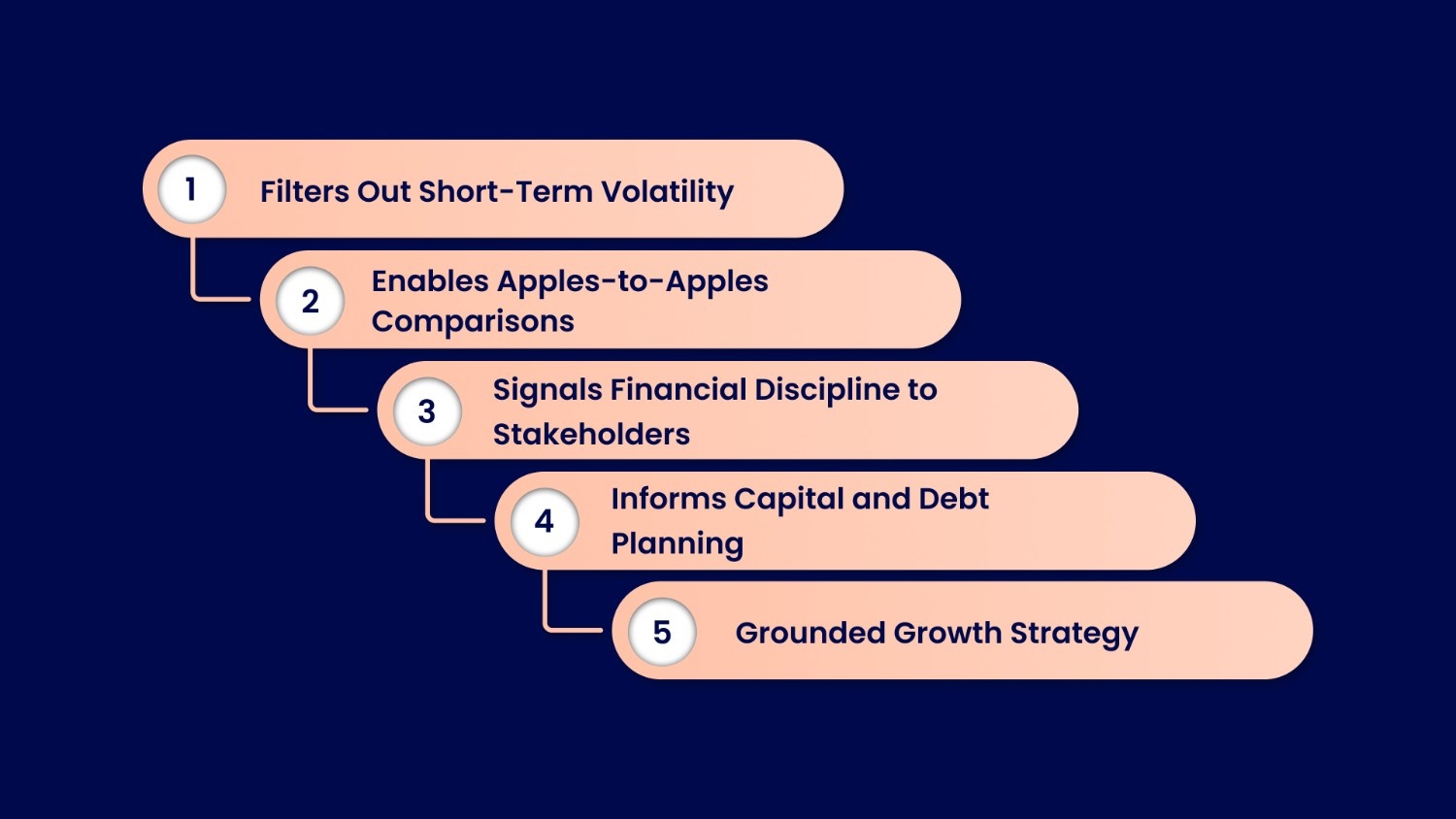
CAGR matters because it helps answer practical, high-stakes questions about growth and capital readiness:
- Filters Out Short-Term Volatility
Cuts through monthly or quarterly fluctuations to show how consistently the business is growing over time. - Enables Apples-to-Apples Comparisons
Creates a standard metric to compare performance across years, product lines, markets, or strategic phases. - Signals Financial Discipline to Stakeholders
Indicates revenue stability and operating discipline, key signals lenders and advisors look for when evaluating non-dilutive funding. - Informs Capital and Debt Planning
Helps teams assess whether projected cash flows can reliably support debt obligations and repayment schedules. - Grounded Growth Strategy
Aligns expansion plans with financial reality by emphasizing repeatable, predictable revenue rather than one-off growth spikes.
When used alongside cash-flow and unit economics analysis, CAGR becomes a reliable indicator for scaling responsibly, without adding unnecessary financial pressure.
Unlock funding tied to your CAGR trajectory. Recur Swift offers collateral-free loans up to ₹10 Cr for startups with >₹5 Cr revenue, 48-hour term sheets.
What Is a Good CAGR?
There’s no single “good” CAGR, it depends on your business model, scale, and stage. For Indian SaaS and D2C businesses, CAGR is less about hypergrowth and more about consistency and predictability.
As a general reference:
- 10–15% CAGR may be acceptable for mature or capital-efficient businesses prioritising profitability
- 15–25% CAGR signals healthy, sustainable growth for many post-Series A SaaS and D2C companies
- 25%+ CAGR indicates strong momentum, but often comes with higher execution risk and cash burn
What matters most is not just the number, but whether your CAGR is:
- Supported by repeatable revenue (subscriptions, repeat customers)
- Achieved without excessive discounting or working-capital strain
- Predictable enough to service fixed obligations like debt repayments
For lenders and finance partners, a stable CAGR backed by clean cash flows often matters more than an aggressive but volatile growth rate.
CAGR vs Other Growth Metrics (When to Use What)
CAGR is a powerful metric, but it’s not the only way to look at growth. For founders and finance leaders, the key is knowing which metric fits the decision you’re making.
In practice, CAGR is most useful when you want to answer:
“How steadily has this business grown over time, and can that growth support the next phase of scale?”
Used alongside YoY growth and cash-flow metrics, CAGR provides a clearer foundation for planning and non-dilutive funding decisions.
Limitations of CAGR (What Founders Should Watch Out For)
.jpg)
While CAGR is a powerful metric, it has limitations that founders and finance teams should be aware of.
- It assumes smooth growth that rarely exists: CAGR masks the ups and downs of real operations. A strong CAGR can hide periods of slowdown, churn spikes, or margin pressure that affect cash flow and risk.
- It ignores the path of growth: Two businesses can report the same CAGR while having very different journeys. Front-loaded losses followed by a late surge carry different risks than steady, incremental growth, something CAGR alone cannot show.
- It’s sensitive to the time window chosen: Short timeframes can exaggerate growth, while longer ones may understate recent improvements. Always evaluate CAGR alongside recent trends and trailing performance.
- It doesn’t reflect cash flow quality: CAGR measures growth in revenue or value, not how efficiently that growth converts into cash. For debt planning, lenders will also look at collections, margins, and working-capital cycles.
For these reasons, CAGR should be used as a starting point, not a standalone decision metric. Pair it with cash flow analysis, unit economics, and recent performance to get a complete picture.
Practical Use Cases for Businesses
In practice, businesses use CAGR to:
- Track revenue growth over 3–5 years
- Assess how quickly a product or market is scaling
- Compare performance before and after strategic changes
- Support forecasts used in budgeting and funding plans
When CAGR shows stable growth, finance teams often explore ways to fund expansion without giving up equity.
For startups showing strong, predictable CAGR, fast access to non-dilutive capital can help maintain momentum. Recur Swift supports growing businesses that need quick funding aligned with revenue trends rather than equity dilution.
As businesses mature, the focus often shifts from speed to structure.
For larger SMEs with multi-year growth visibility, Recur Scale helps structure secured funding that matches longer-term cash flows and expansion plans.
Conclusion
CAGR is one of the most useful metrics in finance because it cuts through volatility and highlights long-term growth trends. Used correctly, it helps businesses evaluate performance, communicate progress, and plan ahead with more confidence.
When growth becomes clearer, capital decisions become easier too. If you’re using financial metrics like CAGR to plan your next phase of growth, working with the right funding partner matters.
Recur Club helps startups and SMEs access non-dilutive capital aligned with their growth trajectory, so funding decisions support long-term outcomes, not short-term pressure.
Consult with capital advisors at Recur Club.
FAQs
1. Why do founders and CFOs use CAGR in finance?
CAGR shows how consistently a business has grown over time, cutting through monthly or quarterly volatility. It’s commonly used in board discussions, forecasting, and lender conversations to explain long-term growth clearly.
2. Is CAGR more important than year-on-year growth?
Both matter. YoY growth shows recent momentum, while CAGR reflects multi-year consistency. For funding and debt planning, lenders often care more about stable CAGR backed by predictable cash flows.
3. Can CAGR be misleading for SaaS or D2C businesses?
Yes, if used alone. CAGR smooths growth and can hide churn spikes, discount-led growth, or margin pressure. That’s why it should be reviewed alongside cash flow and recent performance.
4. What time period should be used to calculate CAGR?
A 3–5 year period is common. Shorter periods can exaggerate growth, while longer ones may dilute recent changes. Recent trends should always be considered alongside CAGR.
.png)