Growth Stage Venture Capital: Key Decisions Founders Must Make

Growth stage venture capital is not just a larger funding round. It is a structural choice that shapes how a company scales, deploys capital, and manages execution risk.
As Indian businesses mature, growth capital is used to expand markets, strengthen leadership, and improve efficiency, all requiring far greater financial discipline than early-stage funding. This shift mirrors a broader move toward structured capital, with SIDBI’s MSME Pulse 2025 reporting institutional credit to MSMEs above ₹35 lakh crore as of March 2025.
For founders and finance leaders, knowing when growth stage venture capital is the right choice has become essential to scaling responsibly.
Key Takeaways
- Growth stage venture capital accelerates execution, not discovery: It works best when the business model is proven and the primary risk is scaling efficiently.
- Readiness is operational, not narrative: Predictable revenue, disciplined financials, and scalable processes matter more than storytelling at this stage.
- Capital increases pressure as much as it increases opportunity: Larger cheques compress timelines, reduce flexibility, and raise performance expectations across the organisation.
- Dilution is only part of the cost: Governance, exit alignment, and reduced strategic freedom are long-term trade-offs founders must price in.
- The smartest growth strategies blend capital types: Combining venture capital with structured, non-dilutive funding can preserve ownership while sustaining growth.
What Is Growth Stage Venture Capital Funding
Growth stage venture capital is equity funding raised by companies that have already proven demand for their product or service. At this stage, the business is no longer validating whether it should exist, but focusing on how fast and efficiently it can scale.
This form of capital is used to accelerate an established model. The emphasis shifts from experimentation to execution, with funding deployed to expand markets, strengthen teams, and improve operational capacity.
From an investor perspective, growth stage venture capital targets businesses with visible revenue traction and repeatable performance. Decision-making relies more on execution quality and capital efficiency than on long-term vision alone.
Also read: B2B SaaS Funding in India: A Complete Guide to Growth Capital
When Companies Are Actually Ready For Growth Stage Venture Capital
Readiness for growth stage venture capital is defined by operational maturity rather than headline valuation or brand visibility. Investors look for signs that the business can absorb larger amounts of capital without losing control over execution.
At this stage, growth is no longer driven by experimentation. Revenue patterns show consistency, customer acquisition follows a repeatable process, and internal systems can support expansion without constant firefighting.
Signals Investors Look For Before Deploying Growth Capital
- Predictable revenue with improving visibility across quarters
- A go-to-market motion that can be scaled without linear cost increases
- Unit economics that hold as volumes grow
- Leadership depth beyond the founding team
These signals indicate that additional capital will amplify performance rather than expose structural weaknesses.

How Growth Stage Venture Capital Works In Practice
Growth stage venture capital is typically raised through a priced equity round with clearly defined ownership and governance expectations. Investors deploy larger cheques with the intent of accelerating scale rather than extending runway for experimentation.
At this stage, capital comes with higher involvement. Boards become more active, reporting cadence increases, and decision-making is closely tied to execution milestones rather than exploratory goals.
What Changes After A Growth Stage Round
- Ownership stakes are larger and dilution becomes more meaningful
- Governance expectations increase, including board oversight and formal controls
- Capital deployment is tracked against specific growth outcomes
Growth stage capital works best when companies are prepared for this shift from founder-led intuition to institution-led accountability.
Also read: Guide to Financing Options for SaaS Startups
How Growth Stage Venture Capital Is Deployed Inside Companies
Growth capital is used to scale existing strengths, not to reinvent the business. Deployment decisions focus on removing constraints that limit growth velocity.
Companies that deploy growth capital effectively concentrate spending on a small number of priorities rather than pursuing multiple parallel initiatives.
Where Growth Capital Is Typically Deployed
- Market or geographic expansion using proven distribution models
- Senior leadership and functional hiring to support scale
- Technology and infrastructure investments that improve efficiency
- Selective acquisitions or partnerships that accelerate reach
Poor deployment often creates complexity without proportional return.
Growth Stage Venture Capital Compared To Other Growth Financing Options
Growth stage venture capital is one of several ways to fund expansion. Its defining feature is the trade-off between speed and ownership.
Compared to late-stage venture capital or private equity, growth stage VC sits earlier in the maturity curve and carries higher execution risk. Compared to non-dilutive funding, it prioritises pace over capital efficiency.
Where Growth Stage Venture Capital Is The Best Fit
- Markets where speed determines competitive outcomes
- Businesses prioritising scale over near-term profitability
- Founders willing to trade ownership for accelerated expansion
VC is most effective when time matters more than control.
Trade-Offs Founders Make When Raising Growth Stage Venture Capital
Raising growth stage venture capital changes how risk is distributed across the business. Capital accelerates outcomes, but it also tightens timelines and expectations.
- Dilution is the obvious trade-off: Larger cheques come with meaningful ownership loss that is difficult to reverse in later rounds.
- Control reduces as execution commitments increase: Growth investors expect capital to be deployed predictably, leaving less room for strategic detours or extended experimentation.
- Performance pressure rises sharply after the round: Targets become externally visible, hiring plans lock in, and course correction becomes harder once capital is committed.
For founders, the trade-off is structural. Growth stage venture capital offers speed and market advantage, but it requires alignment with investor timelines, exit expectations, and governance discipline.
Also read: Understanding Causes and Effects of Equity Dilution
How Founders Should Prepare For Growth Stage Venture Capital
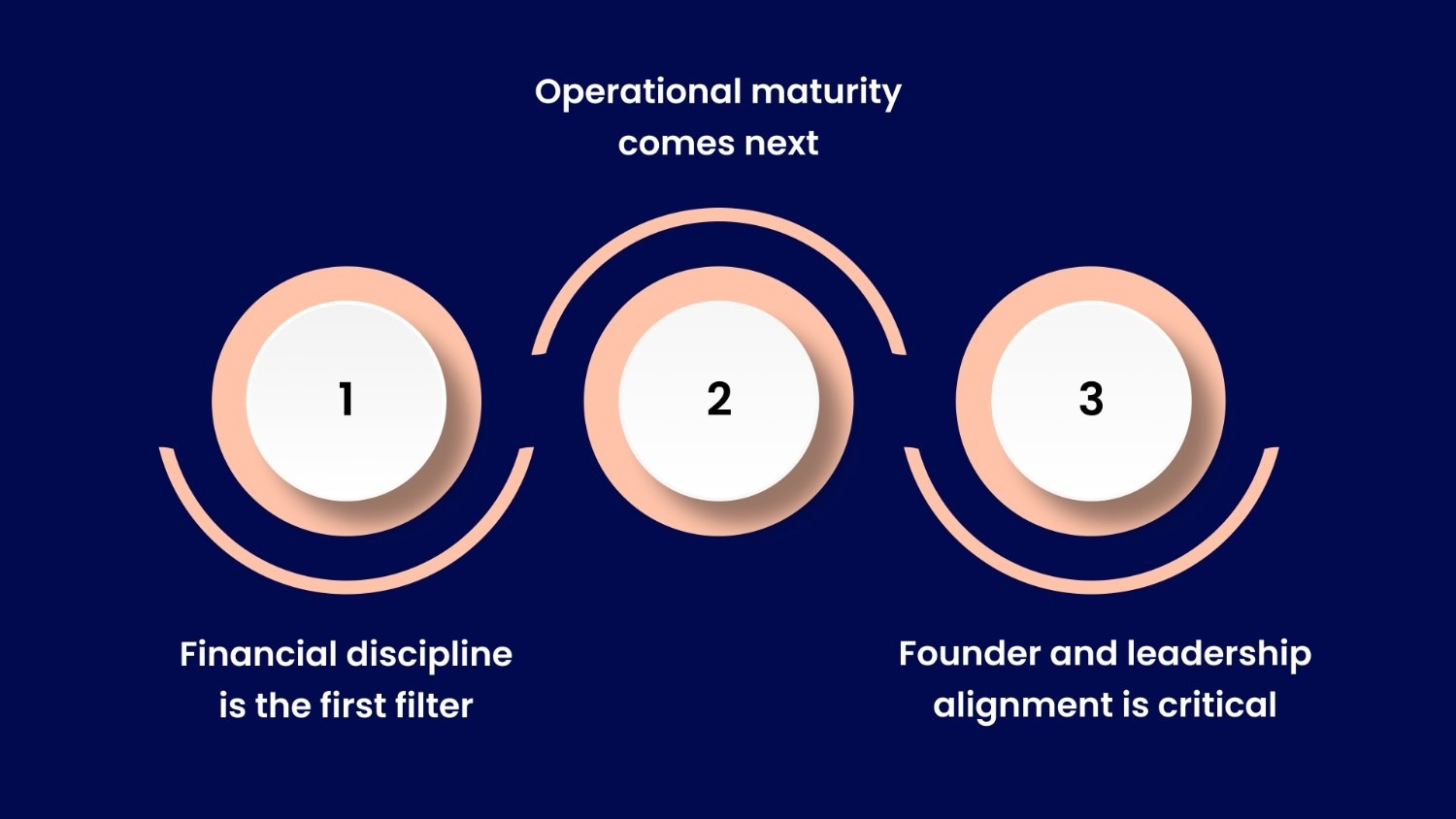
Preparation at the growth stage is less about storytelling and more about operational readiness. Investors assume the core narrative is proven and focus on execution risk.
Financial discipline is the first filter.
- Forecasts should be realistic and internally consistent
- Unit economics must be well understood and defensible
- Reporting cadence should already reflect scale expectations
Weak financial control at this stage magnifies pressure once capital is raised.
Operational maturity comes next.
- Clear ownership across functions
- Processes that work without founder intervention
- Decision-making that scales beyond intuition
Growth capital exposes execution gaps quickly.
Founder and leadership alignment is critical.
- Growth funding commits the company to a specific pace
- Strategic disagreements become expensive after the round
Teams that align early retain more flexibility post-raise.

When Growth Stage Companies Look Beyond Venture Capital
Growth stage venture capital is not always the most efficient source of capital for every expansion need. As companies mature, founders begin to separate growth velocity from capital efficiency.
Some scaling requirements do not justify additional dilution. Businesses with predictable revenues and improving margins often prefer capital that supports expansion without resetting ownership or governance dynamics.
Companies typically look beyond venture capital when:
- Growth is steady rather than explosive
- Cash flows are visible but uneven
- Expansion requires working capital or capacity, not market discovery
- Founders want to preserve ownership flexibility
At this stage, capital decisions shift from fundraising momentum to balance sheet design. The focus moves toward structuring capital that fits operating realities rather than maximising valuation. For example, with the help of Recur Club, Wellversed raised ₹6.5 Cr in debt six times, doubling revenue by aligning funds with expansion needs.
How Structured Capital Complements Growth Stage Venture Capital
Structured capital is used to fund growth without increasing equity dilution. It sits between traditional debt and venture capital, designed for companies with visible revenues and defined operating cycles.
Unlike equity, structured capital does not reset ownership or governance. Unlike standard loans, it can be aligned to cash flows rather than fixed repayment schedules.
Growth stage companies typically use structured capital to:
- Fund expansion where returns are measurable
- Smooth working capital pressure during scale
- Extend runway without raising another equity round
- Preserve flexibility ahead of a larger strategic raise
Capital advisory platforms help founders evaluate these options objectively. Recur Club operates in this layer by helping growth-stage companies structure non-dilutive capital alongside venture funding. Solutions such as Recur Swift support early growth and operational needs, while Recur Scale is used for larger, structured capital requirements as businesses scale.
Used well, structured capital does not replace venture capital. It reduces dependence on it.

Conclusion
At the growth stage, capital does more than fund expansion. It sets the tempo at which a company is forced to execute, hire, and commit to outcomes.
Founders who choose growth capital deliberately, with clarity on dilution, pace, and alternatives, preserve far more strategic flexibility than those who raise on momentum alone. The difference is not how much capital is raised, but how intentionally it is structured.
If you are planning your next phase of growth, connect with Recur Club to evaluate funding structures that fit your operating model.
FAQs
Q: What is growth capital in venture capital?
A: Growth capital in venture capital refers to equity funding raised by companies that have already proven product market fit and are focused on scaling operations. It is used to accelerate expansion rather than validate the business model.
Q: What are the stages of venture capital?
A: The stages of venture capital typically include seed, early stage (Series A), growth stage (Series B and beyond), and late stage. Each stage reflects increasing business maturity, cheque size, and execution expectations.
Q: What are the stages of growth in a new venture?
A: A new venture usually moves through validation, growth, scale, and maturity. The growth stage focuses on expanding markets, building teams, and institutionalising operations.
Q: What happens at the growth stage of a startup?
A: At the growth stage, startups prioritise scaling revenue and strengthening leadership. Capital deployment becomes more disciplined, with less tolerance for experimentation.
Q: When should a startup raise growth stage venture capital?
A: A startup should raise growth stage venture capital once revenues are predictable and the go to market model is repeatable. Raising too early increases dilution risk, while raising too late can slow momentum.
Q: Can startups combine growth stage venture capital with non dilutive funding?
A: Yes, many growth stage companies combine venture capital with structured, non dilutive capital to reduce dilution and extend runway. Platforms like Recur Club help founders evaluate and structure such capital alongside equity funding.
.png)
.jpg)